

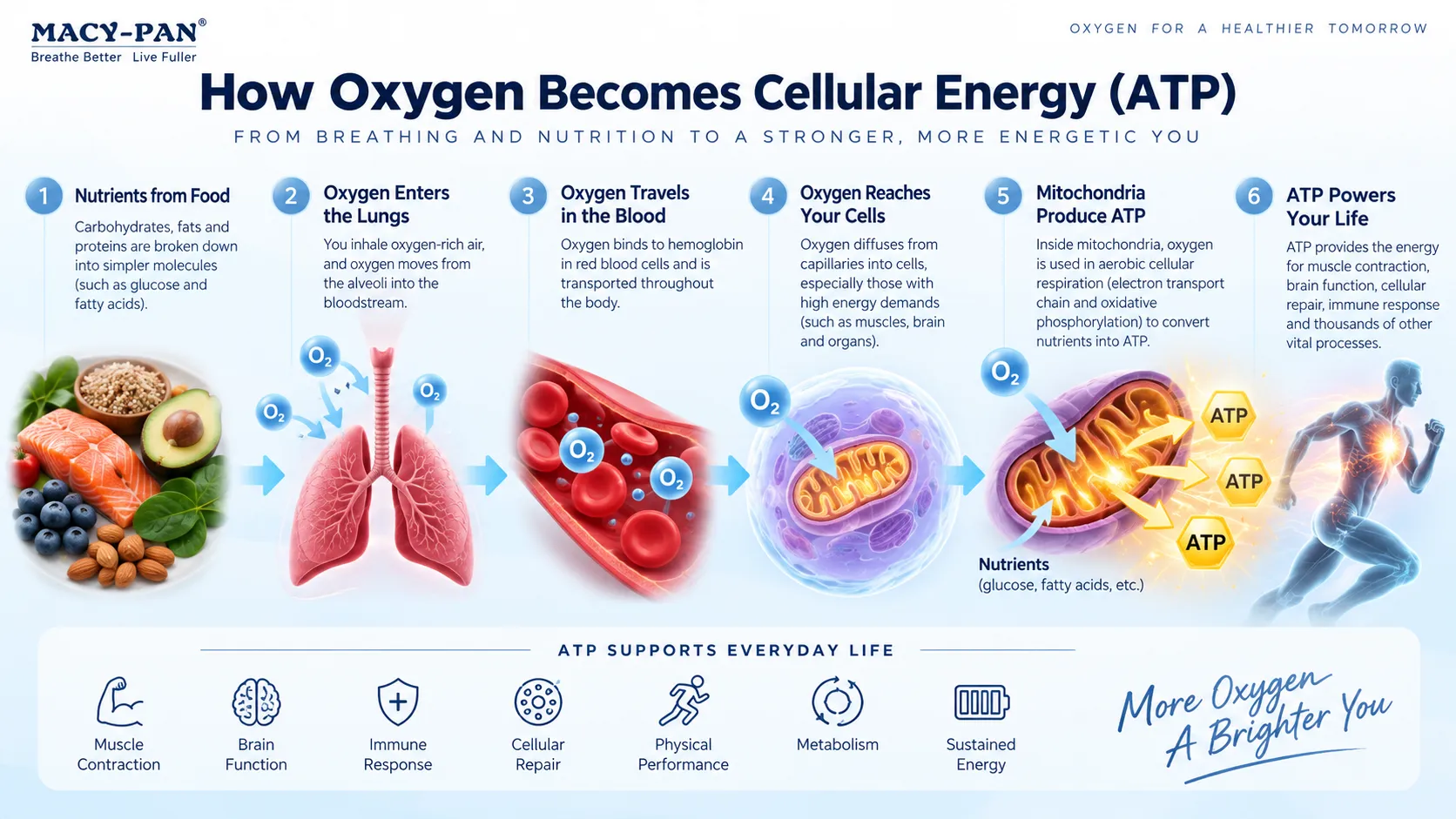
You eat carbohydrates, fats, and proteins for energy—but food alone does not immediately give your cells usable energy.
Before your muscles can contract, your brain can process information, or your heart can continue beating, cells must convert nutrients into a molecule called adenosine triphosphate (ATP).
And oxygen plays a critical role in this process.
This is why questions such as “How does oxygen give you energy?”, “Can low oxygen make you tired?”, and “Can oxygen therapy help with fatigue?” are more complicated than they initially appear.
Oxygen itself is not a stimulant like caffeine, nor is it a calorie-containing fuel. Instead, it enables mitochondria to extract energy from nutrients efficiently through aerobic cellular respiration.
Understanding that mechanism provides a much better explanation of the relationship between oxygen, cellular energy, physical recovery, and fatigue.
Oxygen does not directly contain energy.
Instead, your cells use oxygen during aerobic cellular respiration to efficiently convert energy stored in nutrients into ATP—the immediately usable energy currency of the cell.
The simplified process looks like this:
Food → Glucose/Fatty Acids → Cellular Respiration → Oxygen Utilization → ATP → Cellular Work
ATP then powers thousands of biological processes, including:
muscle contraction;
nerve signaling;
protein synthesis;
active transport across cell membranes;
tissue maintenance and repair;
temperature regulation;
and normal organ function.
This explains why adequate oxygen delivery is fundamental to normal energy metabolism.
But it also reveals an important distinction:
More oxygen does not automatically mean more energy.
In a healthy person with normal blood oxygen saturation, oxygen availability may not be the factor limiting ATP production.
To understand why, we need to look inside the cell.
Taking a breath is only the beginning of oxygen's journey.
For oxygen to participate in cellular energy production, several biological systems have to work together.
When you inhale, oxygen-rich air reaches microscopic air sacs in the lungs called alveoli.
Across the thin alveolar-capillary membrane, oxygen diffuses from the lungs into the bloodstream.
Most oxygen in the blood binds to hemoglobin, the oxygen-carrying protein inside red blood cells.
The cardiovascular system then transports oxygenated blood throughout the body.
This means that normal oxygen delivery depends on much more than breathing alone.
It also depends on:
Lung function + hemoglobin concentration + blood flow + cardiovascular function + tissue oxygen extraction
A disruption anywhere along this pathway can affect tissue oxygen availability.
As blood reaches peripheral tissues, oxygen moves from the capillaries into surrounding cells.
Cells with high metabolic demands—such as heart muscle, skeletal muscle, the brain, kidneys, and liver—require continuous energy production.
Inside these cells are mitochondria.
These microscopic structures are often described as the cell's “powerhouses” because they are responsible for producing much of the ATP used during aerobic metabolism.
This is where oxygen becomes especially important.
Aerobic cellular respiration occurs through several interconnected metabolic pathways, including:
glycolysis;
conversion of pyruvate to acetyl-CoA;
the citric acid cycle (Krebs cycle);
the electron transport chain;
oxidative phosphorylation.
The final stages occur within mitochondria.
During the electron transport chain, electrons move through a series of protein complexes in the inner mitochondrial membrane.
This process creates a proton gradient.
ATP synthase then uses that gradient to generate ATP.
At the end of the electron transport chain, oxygen acts as the final electron acceptor, combining with electrons and hydrogen ions to form water.
Without sufficient oxygen, oxidative phosphorylation cannot continue normally.
That is the biochemical connection between oxygen and cellular energy production.
The difference between aerobic and anaerobic metabolism illustrates why oxygen is so important.
During glycolysis alone, one glucose molecule produces a net yield of only about 2 ATP molecules.
When oxygen-dependent mitochondrial metabolism is available, complete oxidation of glucose can produce approximately 30–32 ATP molecules per glucose molecule, depending on cellular conditions and how the calculation is performed.
In simplified terms:
| Energy Pathway | Oxygen Required? | Approximate ATP Yield per Glucose |
|---|---|---|
| Glycolysis | No | 2 ATP |
| Aerobic cellular respiration | Yes | ~30–32 ATP |
This is why statements claiming that oxygen simply “creates energy” are incomplete.
A more scientifically accurate explanation is:
Oxygen allows human cells to extract substantially more usable ATP from nutrients through oxidative phosphorylation.
That distinction matters.
When oxygen delivery becomes insufficient relative to metabolic demand, cells cannot rely as effectively on oxidative phosphorylation.
They increasingly depend on less efficient metabolic pathways.
This condition is broadly associated with hypoxia, although hypoxia can have many different causes and degrees of severity.
Possible consequences can include:
reduced exercise tolerance;
weakness;
shortness of breath;
difficulty concentrating;
headaches;
impaired physical performance;
and fatigue.
In severe oxygen deprivation, normal cellular function cannot be sustained and tissue injury can occur.
But there is an important clinical distinction between feeling tired and actually having inadequate oxygen levels.
This is one of the most important questions for anyone searching for oxygen therapy for fatigue.
Fatigue is extremely nonspecific.
Feeling exhausted does not automatically mean your body needs additional oxygen.
Persistent fatigue may be associated with many factors, including:
insufficient sleep;
sleep apnea;
anemia;
iron or vitamin deficiencies;
thyroid disorders;
cardiovascular disease;
pulmonary conditions;
infections;
medication effects;
metabolic disorders;
psychological stress;
overtraining;
inadequate calorie intake;
dehydration;
or other underlying medical conditions.
Consider anemia as an example.
A pulse oximeter might show apparently normal oxygen saturation, yet insufficient hemoglobin can reduce the blood's total oxygen-carrying capacity.
Similarly, someone with normal lungs may still experience fatigue caused by sleep disruption, endocrine dysfunction, nutritional deficiencies, or numerous other conditions.
Therefore:
Fatigue should not be self-diagnosed as oxygen deficiency.
Persistent, unexplained, or severe fatigue warrants appropriate medical evaluation.
Not necessarily.
This is where popular explanations about oxygen and energy often become misleading.
In healthy people at sea level, arterial hemoglobin is normally already highly saturated with oxygen.
If hemoglobin is close to fully saturated, simply breathing additional oxygen cannot continue loading dramatically more oxygen onto hemoglobin.
Think of hemoglobin as a passenger train.
If almost every seat is already occupied, adding more passengers to the station does not dramatically increase the number carried by the train.
However, there is another way oxygen can be transported:
dissolved directly in blood plasma.
This becomes particularly relevant when discussing hyperbaric oxygen.
“Oxygen therapy” is not one single intervention.
Understanding the differences between technologies is essential.
An oxygen concentrator increases the concentration of oxygen delivered to the user.
It is commonly used medically when a patient requires supplemental oxygen, depending on the underlying condition and clinician recommendations.
The surrounding atmospheric pressure, however, remains essentially normal.
Hyperbaric oxygen therapy changes another variable:
pressure.
During HBOT, the body is exposed to an environment above normal atmospheric pressure while oxygen availability is increased according to the system and treatment protocol.
The fundamental physics behind this process is associated with Henry's law:
At a constant temperature, the amount of gas dissolved in a liquid increases with the partial pressure of that gas.
Increasing oxygen partial pressure can therefore increase the amount of oxygen dissolved directly in plasma.
This mechanism distinguishes hyperbaric exposure from simply breathing oxygen under normal atmospheric pressure.
Under normal conditions, hemoglobin carries most oxygen in the blood while only a relatively small amount is dissolved in plasma.
Under appropriately controlled hyperbaric conditions, increased oxygen partial pressure can substantially increase plasma-dissolved oxygen.
Conceptually:
Increased ambient pressure + increased oxygen partial pressure → increased dissolved oxygen → increased oxygen availability to tissues
This physiological mechanism explains why hyperbaric oxygen therapy has established medical applications for specific conditions.
However, it does not mean that HBOT should be described as a universal “energy booster.”
That claim would oversimplify both fatigue physiology and HBOT science.
This question requires a careful distinction between biological plausibility, emerging research, and established clinical indications.
HBOT can alter tissue oxygen availability and has been investigated in several areas involving recovery, exercise physiology, neurological conditions, and fatigue-related symptoms.
Researchers have explored potential effects involving:
tissue oxygenation;
mitochondrial metabolism;
vascular responses;
inflammatory pathways;
recovery following physiological stress;
neuroplasticity;
and certain fatigue-associated conditions.
Some studies have reported improvements in selected patient populations or specific outcome measures.
But these findings should not be generalized to every person who feels tired.
Chronic fatigue is a symptom, not a single disease.
Whether oxygen-based interventions are appropriate depends heavily on the underlying cause.
For example, fatigue resulting primarily from iron-deficiency anemia requires a fundamentally different approach from fatigue associated with pulmonary disease, sleep apnea, post-viral syndromes, or athletic overtraining.
Exercise provides another useful example of the relationship between oxygen and ATP.
When physical activity begins, muscle ATP demand rises rapidly.
The cardiovascular and respiratory systems respond by increasing:
ventilation;
heart rate;
cardiac output;
muscle blood flow;
and oxygen delivery.
During lower-to-moderate intensity exercise, aerobic metabolism supplies a substantial proportion of ATP.
As exercise intensity increases, ATP demand can rise faster than aerobic pathways alone can supply it, increasing reliance on anaerobic energy systems.
After exercise, oxygen-dependent processes continue supporting metabolic recovery.
This is one reason oxygen metabolism has attracted interest in sports recovery and performance science.
However, recreational oxygen use and medically indicated oxygen therapy should not be treated as interchangeable concepts.
The relationship between oxygen and energy becomes even more interesting when mitochondria are considered.
Having oxygen available is only one part of efficient cellular metabolism.
Cells must also be capable of using that oxygen effectively.
Mitochondrial function can be influenced by numerous factors, including:
age;
physical activity;
metabolic health;
nutrition;
oxidative stress;
disease;
medications;
and genetics.
Therefore, a person can theoretically have adequate blood oxygenation while still experiencing problems related to cellular energy metabolism.
This explains why:
Blood oxygen level ≠ total cellular energy status.
ATP production depends on an integrated system rather than a single variable.
Consumer pulse oximeters have made blood oxygen saturation—SpO₂—a familiar health metric.
But SpO₂ measures only one part of the oxygen-delivery system.
A reading does not directly tell you:
how much hemoglobin you have;
how effectively blood reaches every tissue;
how efficiently mitochondria function;
how much ATP your cells are producing;
or why you feel fatigued.
This is particularly important for people searching online for explanations such as:
“My oxygen level is normal, so why am I tired?”
Normal SpO₂ does not rule out many common causes of fatigue.
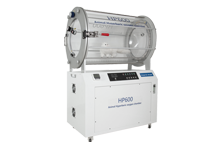
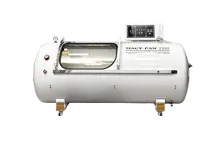
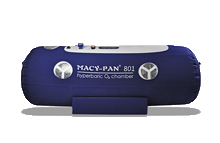
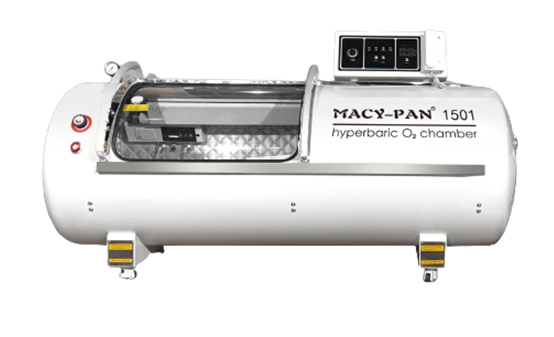
Interest in home hyperbaric chambers has grown among athletes, wellness consumers, recovery centers, and people seeking convenient access to controlled hyperbaric environments.
Home systems may offer advantages such as:
Convenience
Users do not need to travel to a facility for every session.
Consistency
Home access may make following an appropriate protocol more convenient when hyperbaric use has been recommended.
Privacy
Sessions can take place in a private environment.
Long-Term Accessibility
For users who undergo repeated sessions, owning equipment may provide greater logistical flexibility than frequent facility visits.
However, hyperbaric chambers are not ordinary consumer wellness appliances.
Pressure level, oxygen concentration, treatment duration, patient condition, contraindications, fire safety, chamber design, and operating procedures all matter.
Anyone considering hyperbaric oxygen exposure for a medical condition or persistent fatigue should consult an appropriately qualified healthcare professional.
Instead of thinking:
“More oxygen = more energy”
a more accurate model is:
Nutrients provide stored chemical energy.
↓
The digestive and circulatory systems deliver metabolic substrates.
↓
The lungs and cardiovascular system deliver oxygen.
↓
Mitochondria use oxygen during oxidative phosphorylation.
↓
ATP is produced.
↓
ATP powers cellular activity.
This model explains why oxygen is indispensable without turning it into a simplistic energy supplement.
Human energy metabolism is an integrated system.
You need nutrients.
You need healthy lungs.
You need adequate hemoglobin.
You need effective circulation.
You need functioning mitochondria.
And you need oxygen.
When these components work together, cells can continuously regenerate ATP to power the enormous number of biological processes required to keep the body functioning.
This is why oxygen occupies such a fundamental position in human physiology.
At the same time, chronic fatigue should never automatically be interpreted as a sign that someone simply needs “more oxygen.”
Understanding why fatigue occurs is far more important than treating the symptom based on assumptions.
For people exploring hyperbaric technology for wellness, recovery, or other purposes, the best starting point is therefore not:
“Will oxygen give me more energy?”
but rather:
“How does oxygen affect cellular metabolism, and is oxygen availability actually limiting my recovery?”
That is a much more useful—and scientifically meaningful—question.
Not directly. Food provides chemical energy, while oxygen enables mitochondria to efficiently convert energy from nutrients into ATP through aerobic cellular respiration. ATP is the molecule cells use to power most biological processes.
Oxygen serves as the final electron acceptor in the mitochondrial electron transport chain. This allows oxidative phosphorylation to continue and enables efficient ATP production.
Complete aerobic metabolism of one glucose molecule is commonly estimated to produce approximately 30–32 ATP molecules, although the precise yield varies depending on cellular conditions.
Insufficient oxygen delivery can contribute to weakness, reduced exercise tolerance and fatigue. However, fatigue has many possible causes, so feeling tired does not necessarily indicate low oxygen.
Pulse oximetry measures hemoglobin oxygen saturation but does not directly measure anemia, tissue perfusion, mitochondrial function, sleep quality, hormonal status, nutritional deficiencies or ATP production. Many conditions can therefore cause fatigue despite a normal SpO₂ reading.
Not necessarily. Healthy individuals often already have highly saturated hemoglobin under normal conditions. Additional oxygen therefore does not automatically translate into increased ATP production or subjective energy.
Supplemental oxygen increases inspired oxygen concentration under approximately normal atmospheric pressure. Hyperbaric therapy also increases environmental pressure, which increases oxygen partial pressure and can increase the amount of oxygen dissolved in plasma.
HBOT has been studied in several fatigue-associated conditions, but chronic fatigue has many potential causes and HBOT is not a universal treatment for tiredness. Medical evaluation should determine the underlying cause and whether a particular therapy is appropriate.
Home hyperbaric systems exist, but hyperbaric exposure requires appropriate equipment, operating procedures, safety precautions and consideration of individual health conditions. Medical use should be discussed with a qualified healthcare professional.

Discount Price, ship by DHL, door to door service, 5-7days delivery time, local technical support

We supply soft and hard chambers from 1.3-2.0ATA to reach different customers' needs

Create custom uniquea hyperbaric chambers to reach your target market

We have more than 50 distributors around world, looking forward to having you on board.

 français
  Deutsch
  italiano
  العربية
  čeština
  Suomi
Suomi  Polska
  עברי
עברי